

What If AI Is Learning the Wrong Lessons from Farmers??
decades of incomplete, oversimplified data we've been collecting and calling "ground truth" confidently.

In an age where decades of agricultural data from India are being fed into AI models that will increasingly advise us on everything—from farming policy to extension services, education curriculum and financial products—it is worth asking a simple question:
How good is the data we are teaching these systems with?
After observing this sector for nearly three decades, I have come to believe that our biggest challenge is rarely the lack of intent. It is the speed—and the bias—with which we extract information from farmers. We are remarkably efficient at reducing lived knowledge into data points, and then remarkably confident in building technology, policy and investments on top of them.
The problem often begins with the questionnaire.
Not because the questions are wrong, but because they are designed for easy data entry rather than meaningful understanding.
Here is an imagined—but uncomfortably familiar—conversation.
The surveyor is usually young, hastily-trained, and knows exactly which fields need to be filled because those fields are what the survey supervisor said are important.
The farmer, on the other hand, has probably answered versions of the same questionnaire many times. He is mildly irritated, somewhat suspicious, and vaguely hopeful that this conversation might somehow translate into a government benefit.
What follows is less an exchange of knowledge than a negotiation over what fits into predefined boxes.
Q: What is your main profession?
A: Farming. (Do I also mention that I trade forest produce and repair mobile phones in the evenings? Probably not.)
Data Sheet: Primary Profession – Farming
Q: What else do you do?
A: I have cattle and supply milk to the local dairy coop. During the lean season I work as a mason or on other farms. (Should I also explain that I sell my vegetables locally? She will understand that is just part of farming?)
Data Sheet: Secondary Occupation – Dairy, Masonry
Q: What is your educational qualification?
A: ITI in Mechanical Engineering. (No one asked about the computer operator diploma I did on the side, maybe that is not important for a farming surveyor.)
Data Sheet: Diploma
Q: Where did you learn farming?
A: From my father. And before him, my grandfather. (An odd question, really.)
Data Sheet: Knowledge Source – Traditional
Q: How many years of farming experience do you have?
A: I’ve worked on the farm since childhood, but independently for five years. (that will place my total farming life of 25 years, though each year is a new experience.)
Data Sheet: Experience – 5 years
Q: How many crops do you grow?
A: Paddy, groundnut, legumes, vegetables... and a few fruit trees.
Data Sheet: Crop Knowledge – 3.
Q: Where do you get weather information?
A: Radio and my phone.
(Notice the question wasn’t “How do you understand weather?” It was “Where do you get information?”)
Data Sheet: Weather Source – Radio, Mobile App
Q: Where do you get advice on farming practices?
A: From the Agricultural Officer. (But mostly it is from the local input shop owner, but, that is not her interest, surely?)
Data Sheet: Advisory Source – Agriculture Department
Q: Where do you get market prices?
A: Traders, the mandi, other farmers.
(By now, both people know what this survey is really about.)
Data Sheet: Market Information – Trader, Mandi, Farmers
Q: Do you receive market prices on time?
A: No.
(Although delayed prices are only one problem among many—creditors waiting for repayment, transport, moisture, weather, labour availability... but there isn’t a box for those.)
Data Sheet: Market Information Gap – Yes
By the end of this exercise, an experienced farmer with multiple livelihoods, inherited ecological knowledge, practical engineering skills, local market relationships and decades of observation has become this:
Primary Occupation: Farming
Secondary Occupation: Livestock, Masonry
Experience: 5 years
Crop Knowledge: 3–5
Weather Information: Radio, Mobile Phone
Farming Advice: Agricultural Officer
Market Information: Mandi, Trader
Market Information Gap: Yes
A remarkably tidy dataset. Also, a remarkably incomplete human being.
And yet this is precisely the kind of data from which entire sector emerge.
A single field—“Market Information Gap: Yes”—has, for over two decades, inspired countless interventions. In the early 2000s it was village computer kiosks displaying mandi prices on bulletin boards. Today it is a new generation of AI-powered apps, dashboards and digital platforms, many still dependent on a government official somewhere manually updating prices with little incentive to do so.
Somewhere along the way, technologists collectively concluded that if farmers simply knew yesterday’s market prices a little earlier, agriculture would work dramatically better. Everything else quietly disappeared from the dataset.
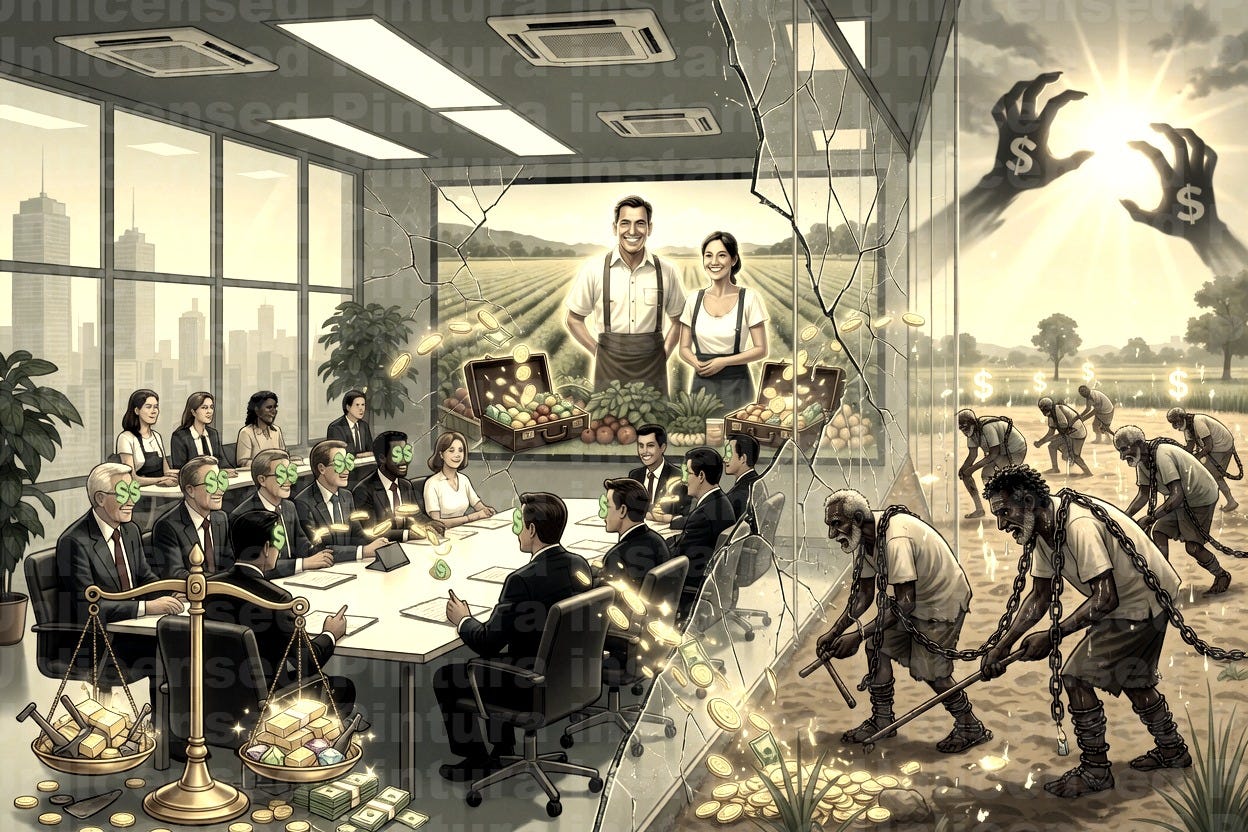
Then come the concept notes. Design documents. Funding proposals. Adoption curves projecting a million farmers in three years. Financial models with colour-coded spreadsheets and elegant pivot tables. Once we hired actors to play farmers in promotional videos. Today we generate photorealistic farmers even speaking local dialects (oh! we have Indianized AI!!) with AI prompts.
The technology has changed dramatically, many careers made and glorified presentations and conferences celebrate their impact. The assumptions behind the data have barely changed at all and that is best reflected in the unchanged challenges of farming and forever unabated farmer suicides.