

Indian Arms Race...
to sustain the prestige of competitive entrance examinations...

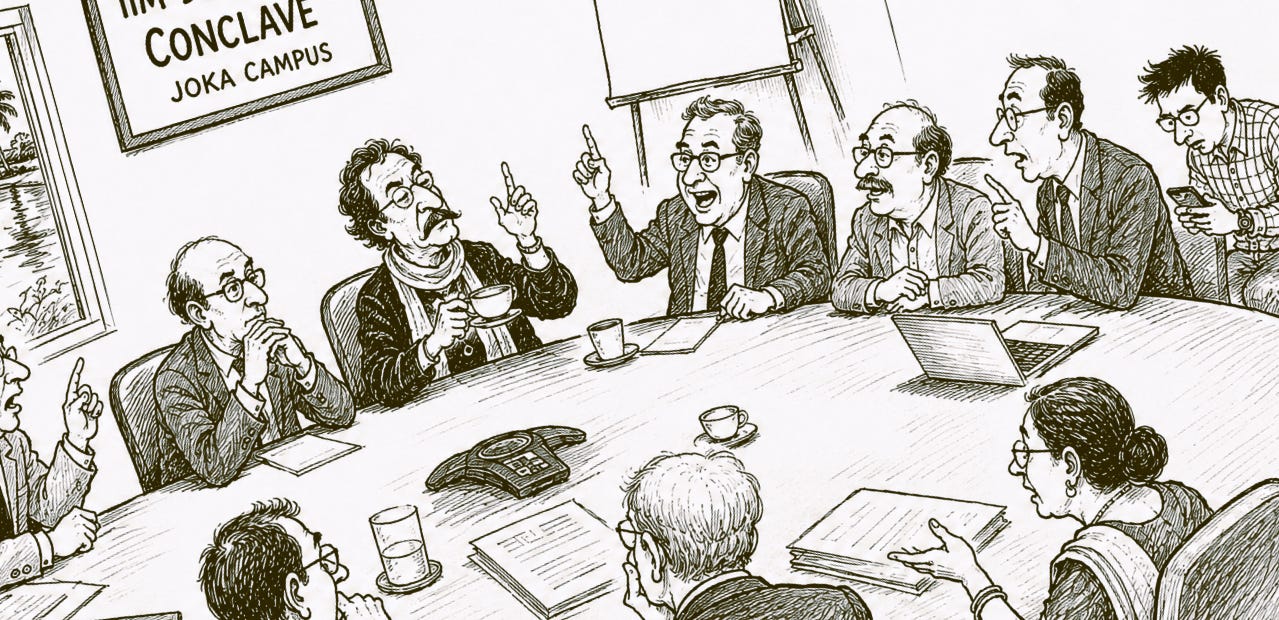
The annual conclave of IIM directors at Joka had, by all accounts, begun badly. This was unfortunate, because Joka had done everything reasonably expected of a campus. The lakes shimmered. The trees swayed with a sort of institutional dignity. Even watching a pair of superstitious monty march past hadn’t helped.
The assembled heads of India’s premier management institutes had gathered under a cloud, a dark and troubling cloud involving prestige. The matter concerned CAT.
For years, the Common Admission Test (CAT) had occupied a comfortable top position in the competitive examination hierarchy. One wrote NEET to become a doctor. One wrote JEE to become an engineer. One wrote CAT to become the sort of person who eventually employed doctors and engineers and made profits. It was agreed, the natural order of things. Unfortunately, recent developments had disturbed the ecosystem.
The Government had announced a series of spectacular security measures for the NEET examination. Question papers would reportedly travel under military protection in air-force jets. Examiners would be isolated, monitored, maybe even an RFID chip implanted, tracked, supervised and possibly observed by encrypted satellites. Rumors circulated that very few invigilators would be visible from low Earth orbit.
The details varied depending on whom one spoke to, but the effect was unmistakable. NEET had suddenly acquired glamour. This was intolerable.
“It is a branding problem,” declared the director of an IIM famous for producing hourly $-billed consultants. “Until now, examination security was an logistic detailing. NEET has converted it into a premium experience.” A silence followed.
Couple of dozen directors stared thoughtfully into the middle distance, where many of India’s management ideas had seemingly originated. “We could transport CAT papers in submarines,” suggested an operations research expert for a moment slipping back to the analogue days of the examination in his suggestion.
The room considered this. “Nuclear submarines”, he embellished the glamour element with an acumen of someone adding an infographic to an online article. Sensing the room considered it even more seriously, he pushed forth, “We make a documentary of the journey, possibly a web series.”
The suggestion was entered into the minutes which is the equivalent of a peer reviewed journal publication in academic bureaucracy.
A distinguished Bengali academic, whose relationship with management theory often appeared to involve divine revelation, shook his head. “You are thinking tactically,” he said. “We must think strategically.”
He removed a fly from the proceedings with the underside of a trained teacup and continued with a hypnotic daze only managed by the likes of a trained tantrik, “NEET is competing on security. We are management professionals. We must compete on efficiency.”
The room brightened.
“Virtual reality.”
“Virtual reality?”
“Every student wears a VR headset. Simultaneous examination. Complete synchronization. Nationwide.”
Several directors nodded vigorously. One had no idea what this meant but felt it sounded expensive, which any educational administrator generally will tell you, is a promising sign.
The southern director seated near the window performed a rapid mental estimate of the procurement costs for 300+ exam centres and found himself unexpectedly pleased with the budget hike.
“There is one issue,” he observed. “Optics.”
The room became pensive again.
Optics had become the oxygen for modern institutional governance. It was no longer sufficient for an activity to occur. It had to occur in a manner suitable for a drone footage.
“Consider NEET,” he continued. “They may soon have ministers flagging off aircraft carrying question papers. There could be ceremonial speeches. Media coverage. Commemorative hashtags that trend all day and even enter the prime-time news.”
A murmur of concern travelled around the table. The VR proposal, admirable though it was, offered very little opportunity for being flagged.
“And frankly,” said the youngest director present, who taught market research and therefore occupied a lower rung in the management academic caste system, “the reels would be disappointing.”
Nobody acknowledged him. He returned quietly to Wordle on his iPhone.
A research scholar proposed that a minister could inaugurate the distribution of VR headsets. The suggestion generated mild interest as it could still involve the submarines.
A strategy professor immediately improved upon it. “We should have a mandatory pre-examination wellness module.”
“What sort of module?”
“CAT-Asanas!” the room came alive.
The strategy professor had spent most of his career unsuccessfully attempting to influence his own department. This was his finest hour. “A series of management-oriented yogic exercises. You see these days IKS carries currency”, he expounded.
The idea acquired momentum. Within minutes the proposal had expanded into a national programme involving virtual reality, mindfulness, a sanskrit chant, examination readiness, nation building, and personal transformation.
Someone suggested an animated national leader (everyone knew) delivering motivational guidance. Someone else suggested compulsory viewing. A technology geek professor suggested that students who appeared distracted could even receive a corrective sensory feedback as such tech was available. The Management Ethics professor objected to this. No one heard him.
By the time the sun along with several nolan-sondesh went down, a delegation had been formed to appraise the Ministry of Education.
The proposal now occupied one hundred and fifty-nine pages and several annexures which contained references to wellness, digital transformation, holistic learning, stakeholder engagement and at least one chapter whose purpose nobody could entirely explain. There was an executive summary that started with a verse from Bhagavan Gita, and had the words optics and safety highlighted several times.
The directors departed in excellent spirits. Prestige, they felt, was once again within reach where it rightly belonged to, after all they trained global corporate millionaire luminaries who sold sweetened aerated drinks and highly processed food to the entire world.
A thousand seven hundred kilometres away, a meeting of IIT directors at IITM with similar concerns towards Joint Entrance Exam (JEE) was producing entirely different forms of techno-solutions.
Unlike the management professors, the IIT professors had spent the first hour discussing the proposed NEET aircraft. They knew its range, payload (or exam paper) carrying capacity, maintenance schedule and fuel consumption. One professor had prepared a comparative presentation on higher capacity aircraft for the JEE papers.
Another had already identified three weaknesses in the propulsion optimisation. A third was disappointed that nobody had requested his eighty-two-slide analysis of carbon reduction techniques. The discussion eventually arrived at the critical issue.
The last time such outrage was felt was when Kota was first searched in the wall maps of the IIT meeting halls. “We are losing the technology leadership. Whoever heard of entrance for medical professions being given such prestigious air-force protection!” was the current outrage consensus.
After all, if medical entrance examinations became associated with advanced military equipment, what remained for institutions that trained the people expected to build advanced military equipment?
Suggestions emerged rapidly to bolster JEE visibly. Stealth bombers. Quantum encryption. Satellite-linked examination systems. Blockchain. Self-destroying question papers.
Each proposal was carefully evaluated before being rejected for reasons ranging from cost to quantum physics and chemical engineering.
After lunch, which included exceptional thayir sadam and vatha molaga, inspiration arrived.
The Artificial Intelligence stood. “We should deploy security robots.”
The room froze. Then erupted. Robots were perfect. Robots suggested technology. Robots suggested security. Most importantly, robots suggested visible ceremonies. The younger amongst directors, immediately grasped the true significance.
“They can be activated from Delhi.” Thunderous applause followed. Every year a button could be pressed. Every year cameras could roll. Every year the nation could witness a new generation of examination-security robots being commissioned.
“But we don’t have such a technology today and using foreign ones will compromise our students’ data”, pitched in a Humanities everyone noticed briefly before she was forgotten again.
The next two hours were devoted entirely to naming the robots in a cultural appropriate manner. Names emerged from several disciplines and were discussed -
Shakthimaan
Examitra
Vigyan Rakshak
Atmanirbhar Sentinel
Exami-Kavach
A politically enterprising even came up with JAI-RAMJEE - J(oyous)-AI activated- R(emote)A(cess)M(oderation)of JEE. Though when pressed he could not impress upon the scientific need for prefix ‘Joyous’
The naming discussion became heated. One professor resigned from a subcommittee. Another threatened to write an oped. A compromise was eventually reached. The robots would receive different names every year.
National harmony was preserved.
Only one complication remained. The preferred security robot was manufactured in China. A brief roomful shudder followed the collective reminiscent of the robot dog in AI convention episode. Then somebody cleverly suggested that online retailers could temporarily hide the product during examination season. The matter was considered resolved.
Similar meetings were also happening at the same time in CLAT, CUET, UCEED, ICAR and other examination centres to discuss strategies to visibly reassure public about the security prowess that the nation possessed and how it was being purposed for the benefit of the next generation. From border military to local police, every security force with their gadgets, ranging from battle tanks to batons were discussed.
As this article goes to press, a high-level committee of defence officials is understood to be examining proposals to improve the prestige of the NDA examination. Though initially taken aback by their aircrafts, submarines and even satellites being usurped by others to enhance exam glamour quotient, the defence services recovered soon enough and decided to adopt innovative thinking approach. Sources indicate that none of their proposals have yet matched the perceived glamour of an Air Force transport aircraft carrying NEET question papers. The committee remains hopeful though.
Delhi Aayog meanwhile, never to be left behind from glamourous action, was rumoured to be mulling an annual rating of the highest tech-enabled security examinations of India. A multi-national consulting firm was hired to hastily produce documents of diverse advanced national origin which can be referenced as benchmarks for such a report. An automated dashboard too is in the anvil. Somewhere in Delhi a couple of interns are allegedly given the task of identifying exotic tourist destinations where a study tour on best practices for tech-examinations could be organized during summer months.
Statutory Disclaimer: This is a pure work of fiction, nothing written above actually took place except a news item. It is written with an intent to laugh and not belittle any institution of higher education or scholarship or for that matter the Government prerogative of providing security to question papers through whatever means they deem fit. My objective is to tickle a bit, have a laugh, maybe think and keep moving.