

Tech-Age (non) Meeting...
this is a real story of a serious interest group meeting in Bangaluru!

The action is unfolding even as I sit waiting for a meeting link on WhatsApp.
The meeting was scheduled to begin 96 minutes ago.
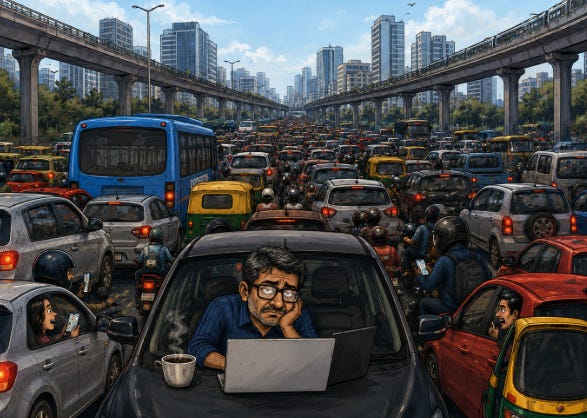
Having responsibly cleared my calendar, brewed an adrak chai, and positioned myself before the computer like a disciplined participant in modern civilization, I felt the moment deserved documentation.
The story began on LinkedIn, where a group of scholars had been conducting a very serious discussion on a very niche subject. Eventually, one among them decided that the matter warranted an actual meeting.
Being based in Bengaluru, he naturally took the traditional first steps: generated a ChatGPT-designed poster, created a WhatsApp group, embedded a QR code into the poster, and shared everything on LinkedIn.
I scanned the QR code and joined the group. Since I do not live in Bengaluru and had no intention of teleporting there, I merely wished to know whether online participation might be possible.
That was two days ago.
Hence my current relationship with the empty space where a meeting link ought to be.
But I am getting ahead of myself.
A great deal happened in those two days.
The subject under discussion was one of those obscure scholarly niches where one expects perhaps a dozen interested people and five actual attendees. The organiser seemed to agree, judging by the choice of venue: a coffee-and-bookshop establishment of the species that now reproduces freely across South India.
Seeing the venue, I was not especially optimistic about receiving an online link. Nevertheless, I informed the organiser that I could join remotely and hoped my existence would remain in institutional memory.
Then came the first surprise.
By the end of Day One, the WhatsApp group had 53 members.
Fifty-three. On this subject.
I was astonished. Surely I am not a minority! I was elated and almost decided to book a ticket and go to Bangaluru. Fantasizing about the IITM project that promised Chennai - Bangaluru in 45 mins by 2030.
Surely Bengaluru’s population of institutional scientists alone could not produce such numbers for a weekday afternoon discussion on a topic that is, at best, tangential to most of their professional lives.
Then again, this is Bengaluru.
Once upon a time it was a science city. Then it discovered technology, startups, stock options, venture capital, $ investments, global expansions and a deep fascination with American way of life. Since then, science has largely been confined to the scientific institutions established before the 1990s, while the city’s economy has expanded outward across former villages and towns until Tamil Nadu appears only a short hop away.
What Bengaluru may have lost in scientific centrality, however, it has more than compensated for in technological economy enthusiasm.
The WhatsApp group provided ample evidence.
Within 48 hours we had achieved:
Three separate distributions of the same digital poster, each carrying minor evolutionary improvements.
Four rounds of venue maps, necessitated by the venue migrating from a coffee shop to a college and then courageously returning to the coffee shop.
One attendance poll, whose results were subsequently immortalised through two different infographics.
A detailed calculation proving that each participant should speak for 3–4 minutes and prepare approximately 450 words, accompanied by the valuable scientific observation that humans speak at roughly 2.5 words per second, therefore:
60 seconds = 150 words
120 seconds = 300 words
180 seconds = 450 words
Three Google Forms:
one for registration
one for deeper questions on the subject
and one exclusively for those attending in person
Two infographics profiling the participants using two different types and multiple colours
An extended discussion on digital tools, including AI systems capable of summarising the meeting afterwards, culminating in a hard-won consensus on the correct summarisation technology.
Meanwhile, subject enthusiasts shared concerns, questions, paper summaries, research references, and, at one point, an entire PDF of article clippings whose purpose remains known only to its compiler.
By now the group was approaching 80 members.
The organiser appeared almost as bewildered as me.
Yesterday, he briefly moved the venue from the coffee shop to a college. Google Maps links were distributed. Carpooling plans emerged from every corner of the city.
This morning, the venue moved back to the coffee shop.
Fresh Google Maps links followed.
Fresh carpooling followed.
Tech-Civilisation marched onward.
The previous evening, a senior professional offered a message of profound wisdom:
“We know the traffic problem in our city, so please plan ahead. I request organisers not to delay and start on time. The meeting is only for three hours, so we cannot waste time.”
The message concluded with additional instructions for drivers.
As I write this, the meeting is 96 minutes past its scheduled start.
I abandoned hope of receiving a link some time ago.
The organiser’s last substantive update arrived 42 minutes after the official start time, announcing that the meeting would begin in five minutes.
Since then, the group has mainly hosted real-time navigation support. Three attendees have posted their live locations (including the senior professional of yesterday’s wisdom) and remaining distances from the venue, while the organiser has diligently assisted them with directions and landmarks.
The actual subject of the meeting has, understandably, taken a temporary back seat.
Yet Bengaluru is merely the most advanced specimen of a broader phenomenon.
Increasingly, we devote more energy to discussing the technologies that mediate human interaction than to the interaction itself.
Consider our current life:
Every purchase, taxi ride, or tea stall transaction requires confirmation that GPay or PhonePe is functioning.
Every wedding invitation must contain a QR-coded Google Maps route.
Every event begins with a WhatsApp group.
Every meeting requires a pre-approved AI summary tool.
Every gathering is preceded by cloud-based data collection.
Every discussion includes at least one distant participant waiting for a link that may or may not arrive.
At this rate, the future may require digital sanctuaries much as we now require digital detoxes.
Protected spaces where gadgets are prohibited.
Places where people calculate change without apps, count notes and coins with their hands, ask strangers for directions, meet one another without prior digital profiling, take notes on paper with pens, and follow up through letters or phone calls.
Radical ideas, certainly.
But perhaps less radical than organising eighty scholars, three Google Forms, four venue maps, two participant infographics, one AI summarisation protocol, multiple carpools, and a WhatsApp group approaching the size of a small municipality, only to discover that nobody has quite managed to start the meeting well beyond half way mark of the duration of the meeting.